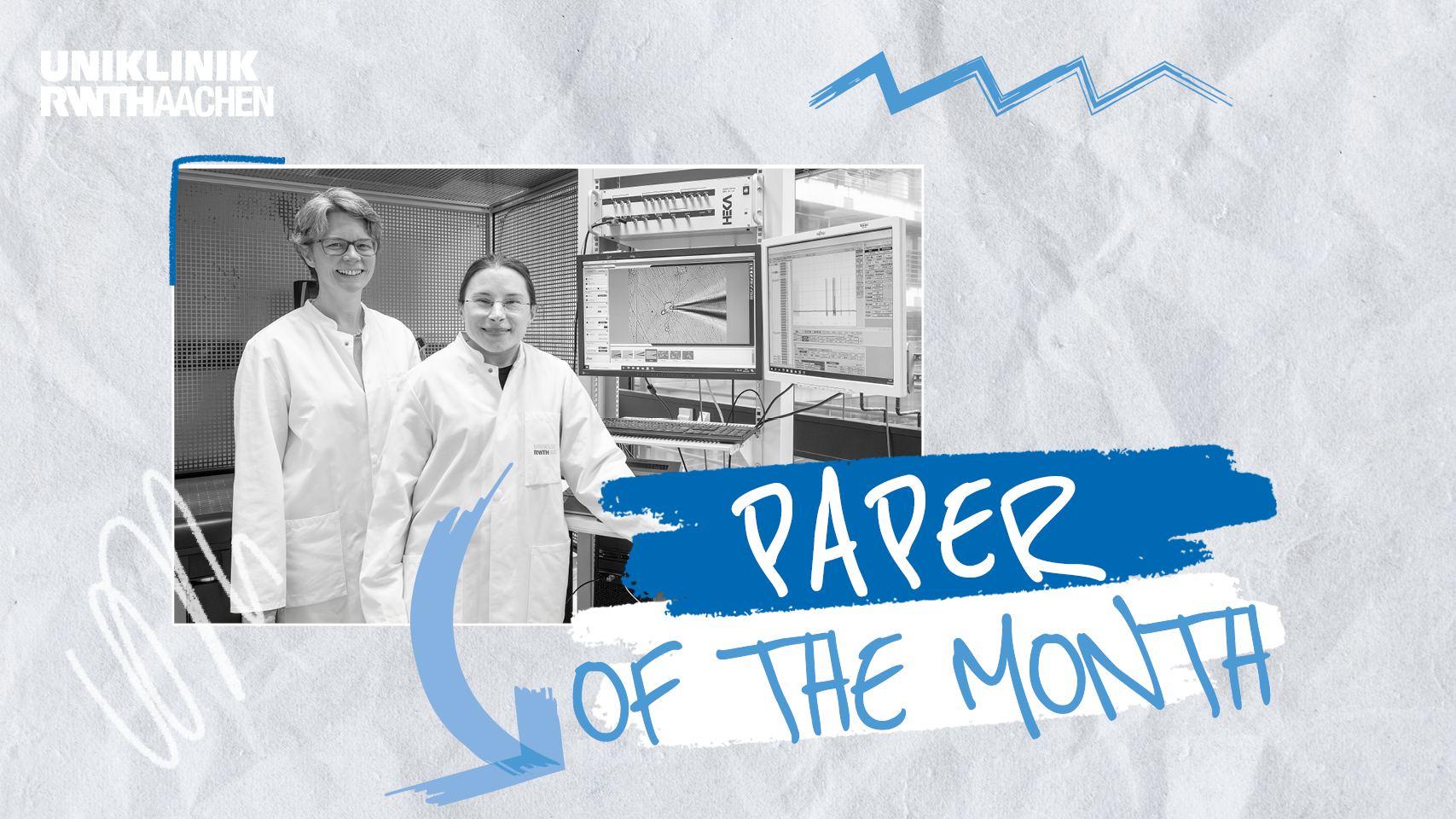
“Paper of the Month” Award for New Study on Spontaneous Activity in Sensory Neurons
Dr. Esther Eberhardt and Prof. Angelika Lampert, together with colleagues from several research institutions, have published a new study in the Journal of the International Association for the Study of Pain titled: “Spontaneous activity in pain patient stem cell-derived sensory neurons arises from one functional subclass.”
The work was honored with the monthly “Paper of the Month” award, which recognizes outstanding publications from the Faculty of Medicine at RWTH Aachen University. Particular emphasis is placed on research achievements of excellent quality that cannot be captured solely by quantitative metrics such as the journal’s impact factor.
A full interview about the publication, offering further insights, is available here:
“Paper of the Month” Award for New Study on Spontaneous Activity in Sensory Neurons
Dr. Esther Eberhardt and Prof. Angelika Lampert, together with colleagues from several research institutions, have published a new study in the Journal of the International Association for the Study of Pain titled: “Spontaneous activity in pain patient stem cell-derived sensory neurons arises from one functional subclass.”
The work was honored with the monthly “Paper of the Month” award, which recognizes outstanding publications from the Faculty of Medicine at RWTH Aachen University. Particular emphasis is placed on research achievements of excellent quality that cannot be captured solely by quantitative metrics such as the journal’s impact factor.
A full interview about the publication, offering further insights, is available here:
The research team has gained new insights into the spontaneous activity of peripheral sensory nerve fibers, which is considered a central mechanism in neuropathic pain. In this study, the cellular basis of this phenomenon was investigated using sensory neurons derived from induced pluripotent stem cells.
The analyses show that these neurons can be divided into four functional subtypes. Spontaneous activity occurred exclusively in a specific subgroup characterized by tonic firing behavior and increased neuronal excitability.
Further investigations revealed that this increased activity correlates with a lowered threshold for triggering action potentials as well as with enhanced spontaneous depolarizations of the cell membrane. These characteristics suggest increased intrinsic excitability in this cell population.
The identified functional subgroup exhibits similarities to mechano-insensitive C-fibers, which show spontaneous activity in clinical studies of patients with neuropathic pain. The results thus contribute to a better understanding of the cellular mechanisms of neuropathic pain and underscore the value of patient-specific cell models for researching disease-relevant processes.