




Social and Affective Neuroscience – AG Wagels
About us
We are the Social and Affective Neuroscience group (AG Wagels) at the Institute for Translational Neuroscience and Clinical Psychology in Aachen. Our team brings together psychologists, biologists, neuroscientists, psychotherapy students, medical doctoral candidates, and students at every stage of their training.
We study how people connect and what happens when that connection breaks down. Using fMRI, fMRI hyperscanning, neurostimulation, behavioral experiments, and psychological assessment, we look at social interaction as it actually unfolds: between two people, in real time, in health and in mental illness. Our goal is not only to describe these processes, but to find points where they can be improved.
Contact:
Univ.-Prof. Dr. Lisa Wagels
Institute for Translational Neuroscience and Clinical Psychology
E-Mail: lwagelsukaachende
Location: MTI 1, Wendlingweg 2
Team
Julia Koch
jukochukaachende
Julia Quedenbaum
jquedenbaumukaachende
Julia Schräder
jschraederukaachende
Fabienne Grigat
fgrigatukaachende
Anna Traut
atautukaachende
Hannah Volley
hvolleyukaachende
Lilly Anna Meidel
lmeidelukaachende
Katharina Rückels
krueckelsukaachende
Maren Schmelz
maren.schmelzrwth-aachende
Christian Ewald
christian.ewaldrwth-aachende
Sara Boccadoro
sboccadoroukaachende
Laura Dukek
ldukekukaachende
Giovanni Bonacina
gbonacinaukaachende
Manuel Krebs
mkrebsukaachende
Research
We investigate how emotions and social interactions are represented in the brain, and how these processes change in mental illness. Rather than studying one brain at a time, we increasingly look at people while they interact with each other: cooperating, competing, arguing, and reconciling.
The questions guiding our work:
- Which neural networks are activated in what ways when we are stressed, angry, or sad?
- How does social communication and interaction succeed; and why does it sometimes fail?
- What are the cognitive patterns in emotion regulation and impulsivity? Where are the imbalances in people with mental illness?
- What individual factors influence our social interactions and emotion regulation?
- How do (close) relationships influence our cognitive control strategies? How is this affected in mental disorders?
Aggression and its neural and hormonal basis
We use several paradigms to study how testosterone, stress, psychological and genetic factors shape reactive and aggressive behaviour.
fMRI hyperscanning
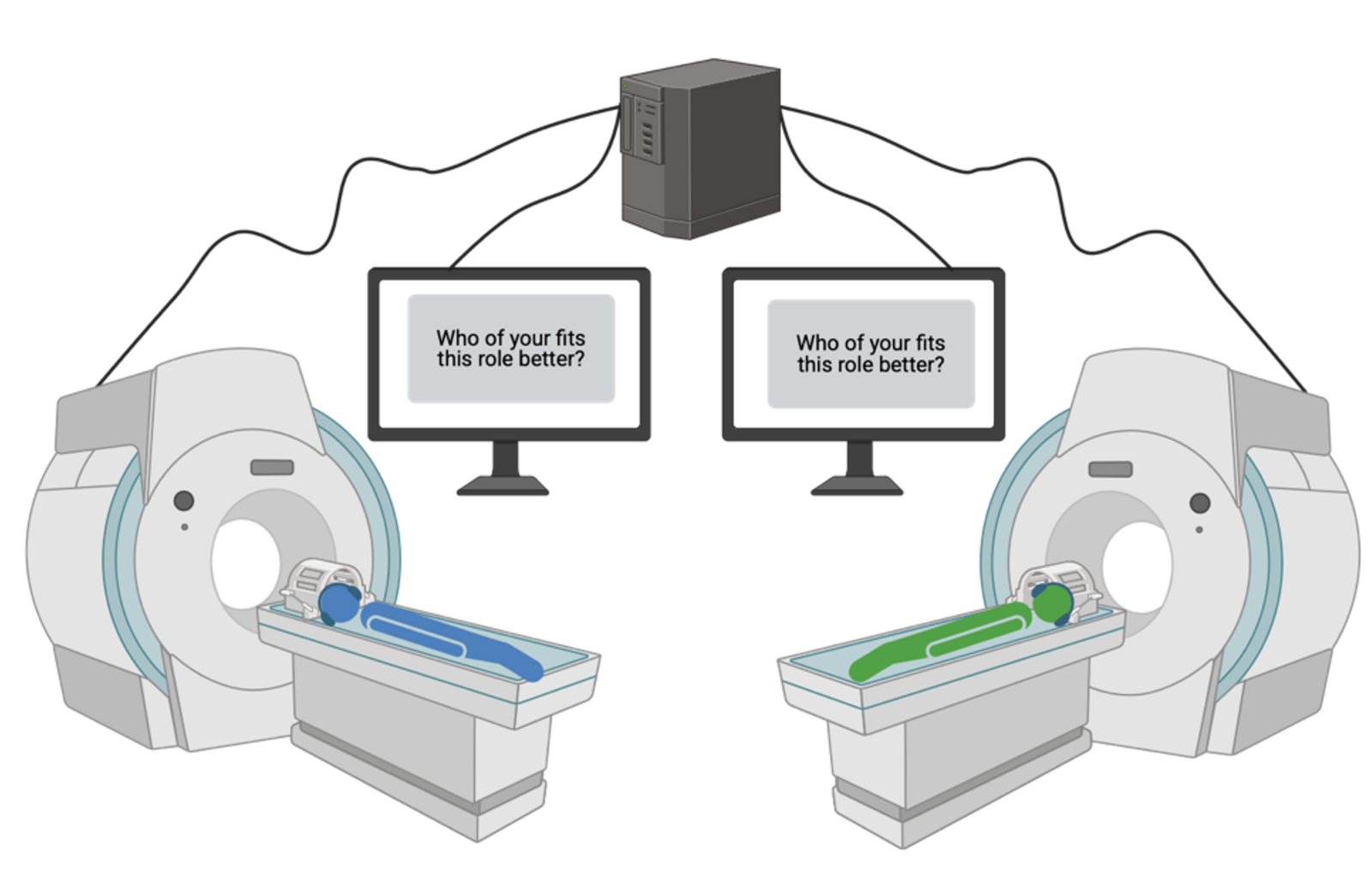
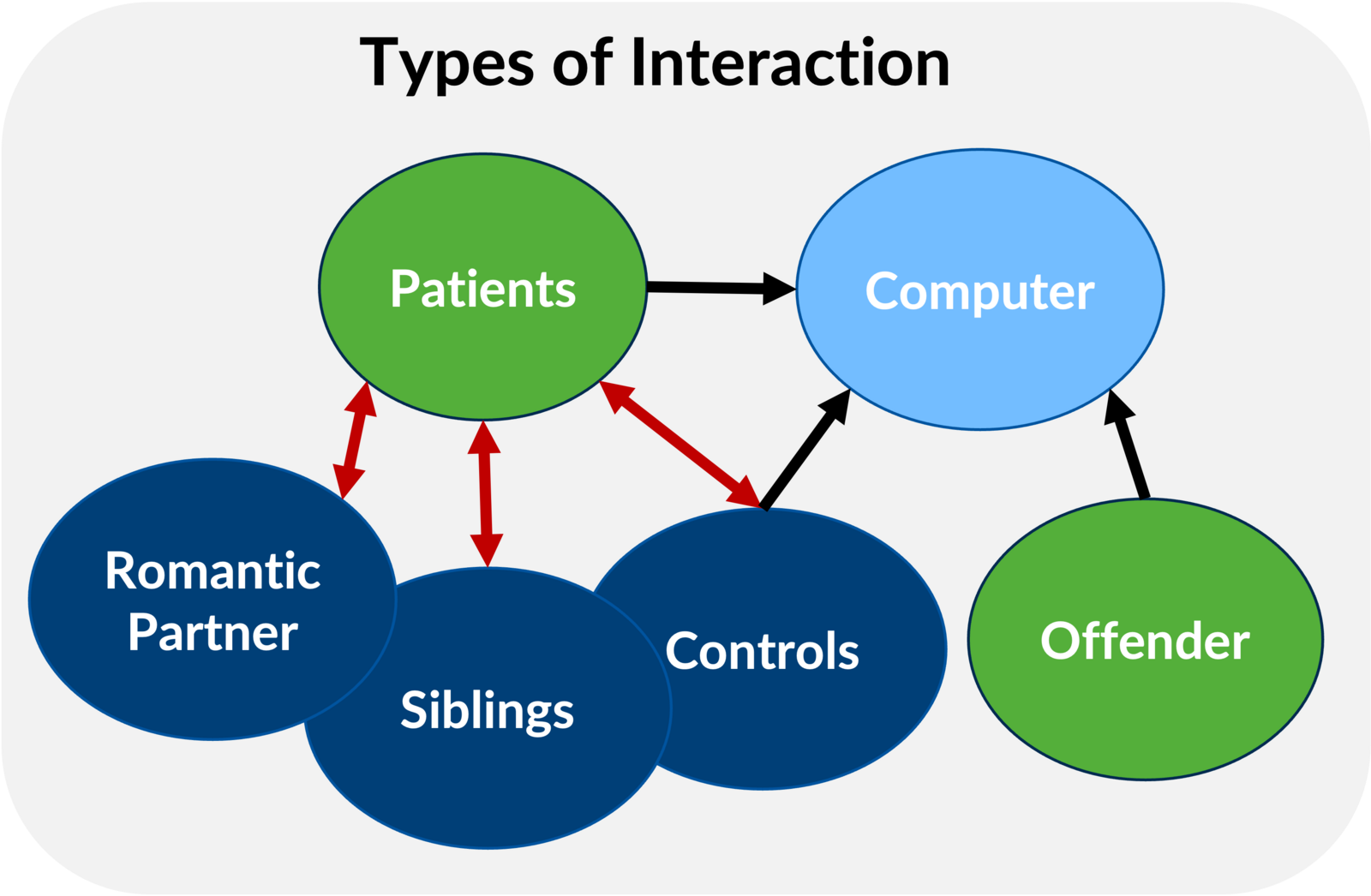
We scan two people at the same time, for example siblings or romantic partners, to capture cooperation, competition, and conflict as they happen between brains rather than within one.
Clinical populations
We extend these paradigms to psychiatric and neurological patients (borderline personality disorder, depression, epilepsy, autism) to identify transdiagnostic mechanisms of aggression and impaired emotion regulation.
Interventions
We test non-invasive neurostimulation (tDCS) and neurofeedback as routes to reduce pathological aggression and strengthen emotion regulation.
Together, this work aims to explain why social interaction succeeds or fails, and to turn that understanding into better treatment for people whose relationships suffer from mental illness.
