
AntiStressShielding
The collaborative research project AntiStressShielding, funded by the German Research Foundation (DFG), addresses the clinical problem of the so-called phenomenon “stress shielding”. This phenomenon occurs in bone tissue surrounding metallic femoral stem implants following their implantation. Due to the pronounced stiffness mismatch between the metallic stem material and the surrounding bone tissue, most of the mechanical stress is taken by the metallic stem. The resulting reduced and non-physiological mechanical loading of the adjacent bone tissue leads to bone resorption and a decrease in bone density. This process can induce aseptic loosening of the implant, which is one of the main causes of prosthesis failure and a reason for revision surgery.
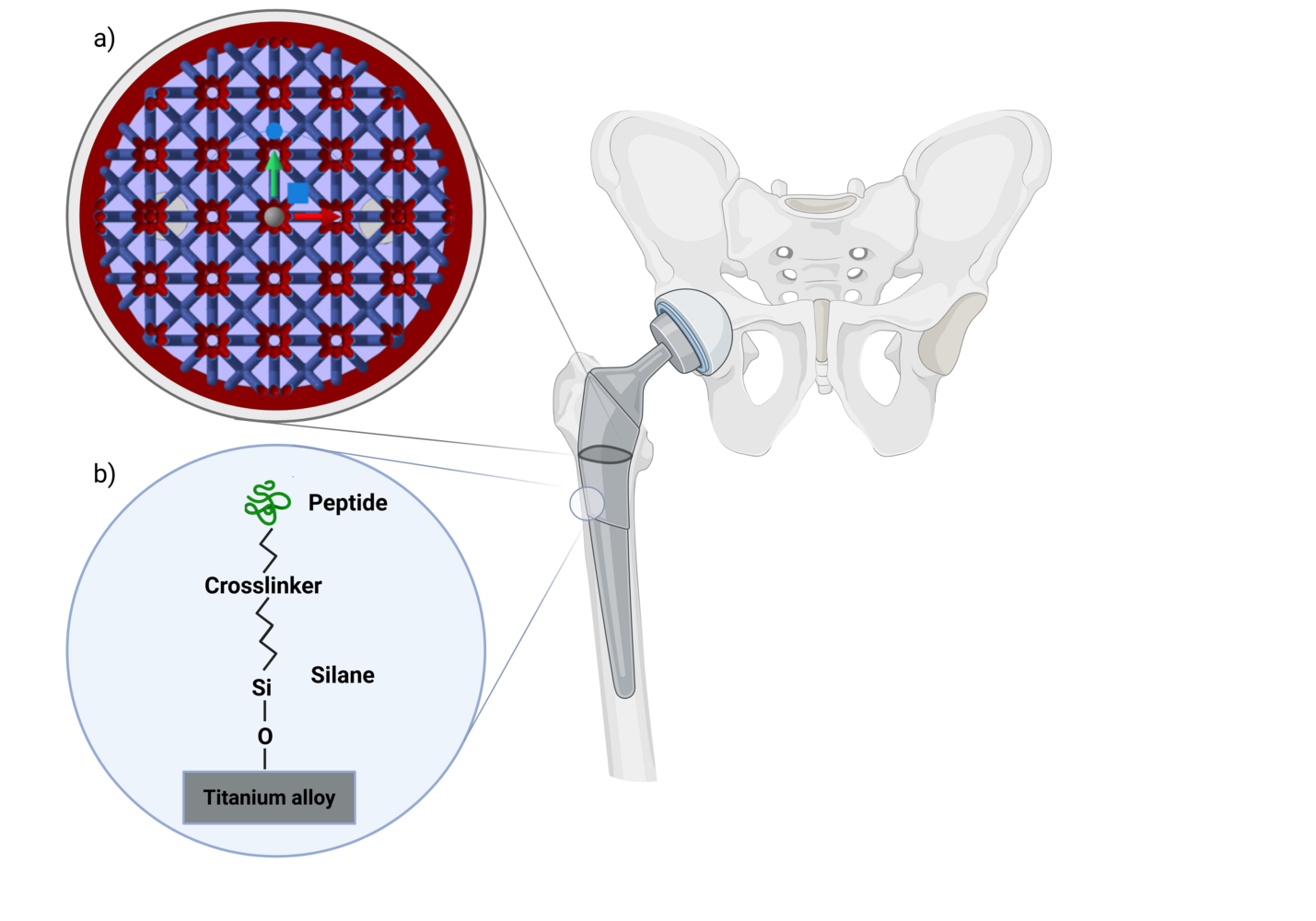
The research project aims to experimentally and numerically evaluate a novel femoral stem implant with reduced stiffness. The goal is to improve osseointegration, thereby minimizing stress shielding effect and ensuring a long-term stable interface between the implant and the surrounding bone. A β-titanium alloy with exceptionally low material stiffness is employed in collaboration with the Steel Institute (IEHK), RWTH Aachen University. In addition, the component stiffness of the femoral stem is further reduced by a tailored lattice architecture (Fig. 1a), which is realized using a selective laser melting process. To enhance osseointegration, the implant surface is organo-chemically functionalized (Fig. 1b). This functionalization enables the immobilization of bioactive molecules on the surface, thereby promoting cell adhesion as well as the osteogenic differentiation of stem cells. In a future in vivo application, this approach could significantly accelerate new bone formation and facilitate the stable integration of the stiffness-adapted implant into the surrounding hard tissue.