
Objectives - Molecular Oncology Group
The main goal of our research group at RWTH Aachen University is the characterisation of new class II tumor suppressor genes (which we call C2TSGs for short), which are often epigenetically downregulated (silenced) in cancer. We are working on C2TSGs in three cancer types: breast cancer, pancreatic cancer and recently also in cholangiocarcinoma (CCA). Our aim is to decipher the molecular signalling pathways in which these new putative tumor suppressors are involved.
One novel ECM tumor suppressor molecule that we were the first group to clone and describe in 2004 is the inter-alpha-trypsin inhibitor H5 (HUGO gene name: ITIH5). ITIH5 may belong to a special class of tumor suppressor genes, as it appears to specifically inhibit tumor progression and metastasis. Such genes are known as metastasis suppressor genes.
Alterations in the WNT signalling pathway, which is essential for normal embryonic development among other tasks, also appear to be of great importance for the development and progression of various tumor types, including breast and pancreatic cancer. In recent years, we have focused on the tumor suppressor gene SFRP1, which encode secreted inhibitors of the WNT signalling pathway that act on neighbouring cells after secretion into the extracellular matrix (ECM).
We hope that the findings from our tumor suppressor gene research can contribute to improving cancer treatment in the long term, as these candidate genes can be used to pursue new therapeutic approaches (C2TSG-based targeted therapies). In addition, epigenetic biomarkers are particularly suitable for the early detection of cancer from body fluids such as blood or urine, which has become known as liquid biopsy diagnostics.
Class II Tumor Suppressor Genes (C2TSGs)
The term "Class II tumor suppressor gene" was already proposed in 1997 by Ruth Sager* (here is a tribute to her scientific life) after finding that many genes in a variety of human cancers rather showed strong down regulation (compared to healthy tissue) than being altered by mutation or deletion.
Class II Tumor Suppressor Genes (C2TSGs) usually have a role in negatively regulating different „Hallmarks of Cancer“, e.g. by reducing cell proliferation, reducing cell migration capacity, supporting apoptosis or differentiation or inhibiting tumor invasion and metastasis. Thus tumor cells seek to regulate down these important genes. Already more than 20 years ago, we have started to discover and further characterize a larger number of new putative C2TSGs by a screening procedure involving EST cDNA libraries. A description of the procedure can be found here*. Starting from 600 genes which were found to be differentially expressed in gynecological tumors 40 particularly interesting C2TSGs were selected, which were characterized in greater detail by the German Human Genome Project (DHGP) consortium "Genetic Basis of Gynaecological Carcinomas" (Dahl et al. Abstract*). Later on our research group characterized further putative C2TSGs (and novel putative oncogenes) by molecular profiling of laser-microdissected matched tumor and normal tissues. (Abstract*) and by in silico analysis of databases like TCGA. (Abstract*)
We characterize novel C2TSG candidates by their effect on tumor cell behavior after forced re-expression in different models of human cancer. An example of the strong inhibitory effect of the tumor suppressor gene ITIH5 on the migratory ability of pancreatic cancer cells can be seen here. The video shows the comparison of the migration speed of PSN1 pancreatic cancer cells expressing ITIH5 (ITIH5 clone 11 and 12, lower row) compared to mock transfected cells that do not (mock clone 1 and 3, upper row). The complete publication on the importance of ITIH5 as a tumor suppressor in human pancreatic cancer can be found here. https://pubmed.ncbi.nlm.nih.gov/38375974/
We are convinced that C2TSGs themselves and the pathways regulated by them may offer novel therapeutic approaches to combat cancer, as we have recently published in a white paper on this topic (https://www.mdpi.com/2072-6694/14/18/4386).
C2TSG-based Targeted Therapies
Class II tumor suppressor genes (C2TSGs) are epigenetically silenced in a high percentage of most human tumors, including breast and pancreatic cancers. These genes have classically not been considered suitable therapeutic targets, as the therapeutic goal would be to upregulate their expression rather than downregulate or inhibit them. This is of course a more complex approach than inhibiting the target and cannot be achieved by conventional drugs such as antibodies or small molecule inhibitors.
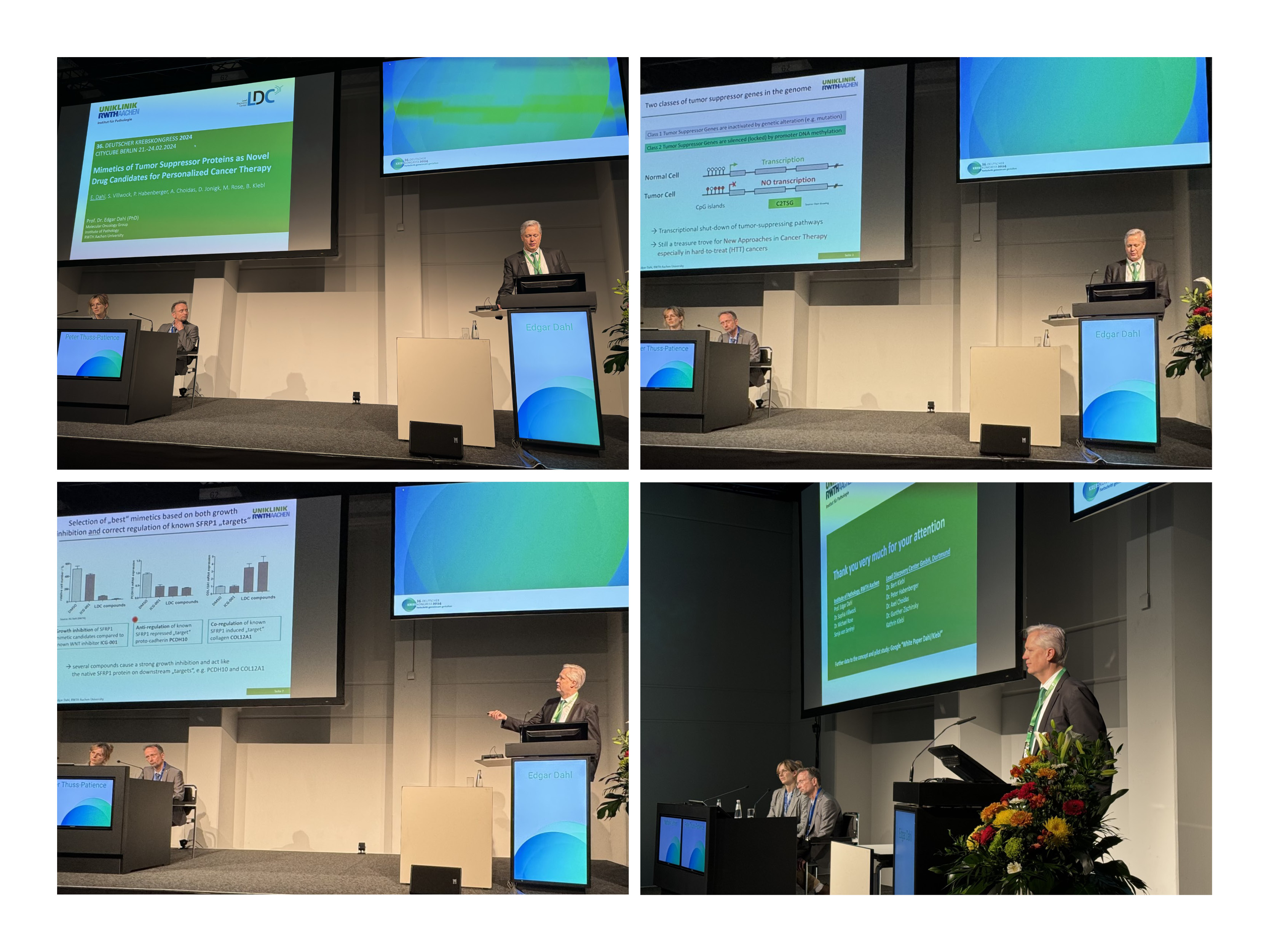
However, nowadays it is possible to search for biological agents or small molecules that can functionally replace (or mimic) the lost tumor suppressor function. Our research group has identified several new C2TSGs in breast cancer, the loss of which is closely associated with a more aggressive tumor type and disease progression. We hypothesize that the functional restoration of these C2TSGs by mimetic drugs represents a new innovative way to treat cancer, a concept that we recently published as a white paper (https://pubmed.ncbi.nlm.nih.gov/36139547/). In addition, this concept was recently presented at the 36. Deutscher Krebskongress 2024 (DKK2024) in Berlin within the Session "Best of Abstracts" by Prof. Edgar Dahl (photos).
An example of a very strong C2TSG in breast (and bladder) cancer is the ITIH5 gene (see Rose et al. 2017; https://www.ncbi.nlm.nih.gov/pubmed/28231808 and Rose et al. 2021; https://pubmed.ncbi.nlm.nih.gov/33924987).
With initial support from the RWTH Aachen Innovation Fund and the recent project acquisition by the RWTH spin-out project Qithera, we are characterizing ITIH5 polypeptides that can mimic the tumor suppressive function of ITIH5 (https://pubmed.ncbi.nlm.nih.gov/35158755/).
A second focus of our research group at RWTH Aachen University is the functional characterization of the inter-alpha-trypsin inhibitor (ITIH) family, a group of secreted proteins that regulate the organization and stability of the extracellular matrix (ECM).
Our work has primarily centered on ITIH5, which we were the first to describe as an extracellular matrix-associated tumor suppressor and Class II tumor suppressor gene (C2TSG). ITIH5 contributes to tissue stability and inhibits tumor progression and metastasis.
More recently, we expanded our research to other ITIH family members. We were the first group worldwide to describe ITIH6, whose biological function is still largely unknown and is currently under investigation.
In addition, we are studying ITIH2, a liver-derived circulating protein that differs fundamentally from ITIH5. Unlike ITIH5, ITIH2 acts systemically and appears to function as a dynamic regulator of the ECM, influencing tissue remodeling, inflammation, and tumor–stroma interactions.
Overall, our research aims to understand how ITIH proteins shape the extracellular environment and how their dysregulation contributes to cancer development. These insights may support the identification of new biomarkers and therapeutic strategies targeting the tumor microenvironment.