
Objectives - Molecular Oncology Group
Our research group at RWTH Aachen University studies genes and proteins whose loss drives cancer progression, and how their function can be restored for therapy. Our work is organized around three closely connected objectives:
- Class II tumor suppressor genes (C2TSGs) are rarely mutated in cancer. Instead, they are frequently silenced by epigenetic mechanisms. Over the past two decades we have identified a number of such genes in gynecological and hepato-pancreato-biliary (HPB) cancers. Today we focus on two of them: the secreted WNT antagonist SFRP1, and the extracellular matrix protein ITIH5. We study both in breast cancer, pancreatic cancer and cholangiocarcinoma (CCA).
- The ITIH protein family. ITIH5, which we first cloned and described in 2004, acts mainly as a metastasis suppressor. Building on this work, we have extended our research to the related matrix proteins ITIH2 and ITIH6, and to their roles beyond cancer, including cardiovascular and metabolic disease.
- C2TSG-based targeted therapies Because C2TSGs are lost rather than activated in cancer, they cannot be targeted with conventional inhibitors. We therefore aim to restore their function with mimetic drugs. For SFRP1, we already pursue this in collaboration with the Lead Discovery Center (LDC) in Dortmund (https://www.lead-discovery.de/en/portfolio/).
Class II Tumor Suppressor Genes (C2TSGs)
The term "Class II tumor suppressor gene" was already proposed in 1997 by Ruth Sager* (here is a tribute to her scientific life) after finding that many genes in a variety of human cancers rather showed strong down regulation (compared to healthy tissue) than being altered by mutation or deletion.
Class II Tumor Suppressor Genes (C2TSGs) usually have a role in negatively regulating different „Hallmarks of Cancer“, e.g. by reducing cell proliferation, reducing cell migration capacity, supporting apoptosis or differentiation or inhibiting tumor invasion and metastasis. Thus tumor cells seek to regulate down these important genes. Already more than 20 years ago, we have started to discover and further characterize a larger number of new putative C2TSGs by a screening procedure involving EST cDNA libraries. A description of the procedure can be found here*. Starting from 600 genes which were found to be differentially expressed in gynecological tumors 40 particularly interesting C2TSGs were selected, which were characterized in greater detail by the German Human Genome Project (DHGP) consortium “Genetic Basis of Gynaecological Carcinomas”. Later on our research group characterized further putative C2TSGs (and novel putative oncogenes) by molecular profiling of laser-microdissected matched tumor and normal tissues and by in silico analysis of databases like TCGA.
We characterize novel C2TSG candidates by their effect on tumor cell behavior after forced re-expression in different models of human cancer. An example of the strong inhibitory effect of the tumor suppressor gene ITIH5 on the migratory ability of pancreatic cancer cells can be seen here. The video shows the comparison of the migration speed of PSN1 pancreatic cancer cells expressing ITIH5 (ITIH5 clone 11 and 12, lower row) compared to mock transfected cells that do not (mock clone 1 and 3, upper row). The complete publication on the importance of ITIH5 as a tumor suppressor in human pancreatic cancer can be found here.
We are convinced that C2TSGs themselves and the pathways regulated by them may offer novel therapeutic approaches to combat cancer, as we have recently published in a white paper on this topic.
The ITIH Protein Family: Matrix Proteins at the Interface Between Tissue Homeostasis and Disease
The inter-alpha-trypsin inhibitor (IαI) family has a long history in matrix biology. Jan J. Enghild and colleagues resolved its unusual architecture, in which heavy chains are covalently linked to the light chain bikunin via a chondroitin sulfate bridge (1991). Jean-Philippe Salier's group cloned the genes and established today's ITIH nomenclature (1996). Koji Kimata and co-workers discovered that the heavy chains become attached to hyaluronic acid (HA) (1993), and Anthony J. Day and colleagues elucidated how TSG-6 mediates this transfer (2005). For a recent overview, see Lord et al. 2020.
Building on this foundation, our group at RWTH Aachen University has studied the ITIH heavy chains for more than two decades. ITIH proteins are large, secreted glycoproteins that organize, stabilize and remodel the extracellular matrix (ECM), and they are frequently deregulated in cancer. Through their interactions with HA, they influence tissue integrity, inflammation and wound healing, as well as how tumors communicate with their surrounding stroma.
We focus on three closely related family members: ITIH5, ITIH6, and ITIH2. Although they share a common evolutionary origin, they differ significantly in where they are expressed and the functions they perform. Our goal is to understand both the common molecular principles and the specific roles that each protein plays in cancer, cardiovascular and metabolic diseases.
ITIH5: From Tumor Suppressor to Regulator of Multiple Organs
Our group first described ITIH5 in 2004 and subsequently identified it as a class II tumor suppressor gene that is frequently silenced by epigenetic mechanisms. We have shown that ITIH5 is lost in breast, bladder, colorectal, lung, and pancreatic cancer. Functionally, ITIH5 inhibits tumor growth and metastasis . Its effects include the epigenetic reprogramming of cancer cells, a shift in TGF-β superfamily signaling, and changes in cell adhesion and migration. Some of these effects are particularly evident in three-dimensional culture models.
Beyond cancer, ITIH5 has been linked to obesity and the regulation of adipose tissue development. It has also been linked to the interaction between fat cells and blood vessel cells (2026), skin homeostasis, and cardiac remodeling following a myocardial infarction (2025).
ITIH6: A newly characterized family member
In 2025, we provided the first functional characterization of ITIH6 (also known as ITIH5L) and identified a tumor-suppressive role in cholangiocarcinoma. ITIH6 is expressed in only a few tissues, which likely explains why it remained uncharacterized for so long. Beyond cholangiocarcinoma, its functions in healthy and diseased tissues remain largely unknown and are the focus of our ongoing research.
ITIH2: The systemic partner
ITIH2 is a circulating heavy chain produced primarily by the liver. Its gene is located directly adjacent to ITIH5 on chromosome 10p14. ITIH2 could therefore link protein production in one organ to matrix remodeling in distant tissues. We are investigating how ITIH2 is processed, transported, and incorporated into tissue matrices, and whether it complements locally produced ITIH5.
Resources and Collaboration
Over the years, we have developed a range of tools for ITIH research, which we are happy to share with academic partners or use in collaborative projects:
- Itih5 knockout mouse: The first and, to date, only phenotypically characterized constitutive Itih5 knockout line on a BALB/c background. The line is available for collaborative projects. * FFPE embedded tissues (various organs including brain) from Itih5 knock-out and WT mouse for comparison
- Antibodies: A polyclonal anti-human ITIH5 antibody that has been comprehensively validated for immunohistochemistry on FFPE tissues (ITIH5 Pineda antibody) and published
- Cell models: isogenic ITIH5 gain-of-function models in breast and pancreatic cancer cell lines
- Vectors: Available for the ITIH genes ITIH2, ITIH5, and ITIH6 to generate stable overexpression lines in human cell lines and to express recombinant proteins in corresponding mammalian systems
If you are working with ITIH proteins, hyaluronic acid-rich matrices, or related disease contexts, we would be delighted to hear from you: Contact: edahlukaachende.
Outlook
Our long-term goal is to establish ITIH proteins as clinically useful biomarkers. We also aim to identify ITIH-dependent signaling pathways that could serve as therapeutic targets for modulating the tumor microenvironment and other matrix-associated diseases.
C2TSG-based Targeted Therapies
Class II tumor suppressor genes (C2TSGs) are epigenetically silenced in a high percentage of most human tumors, including breast and pancreatic cancers. These genes have classically not been considered suitable therapeutic targets, as the therapeutic goal would be to upregulate their expression rather than downregulate or inhibit them. This is of course a more complex approach than inhibiting the target and cannot be achieved by conventional drugs such as antibodies or small molecule inhibitors.
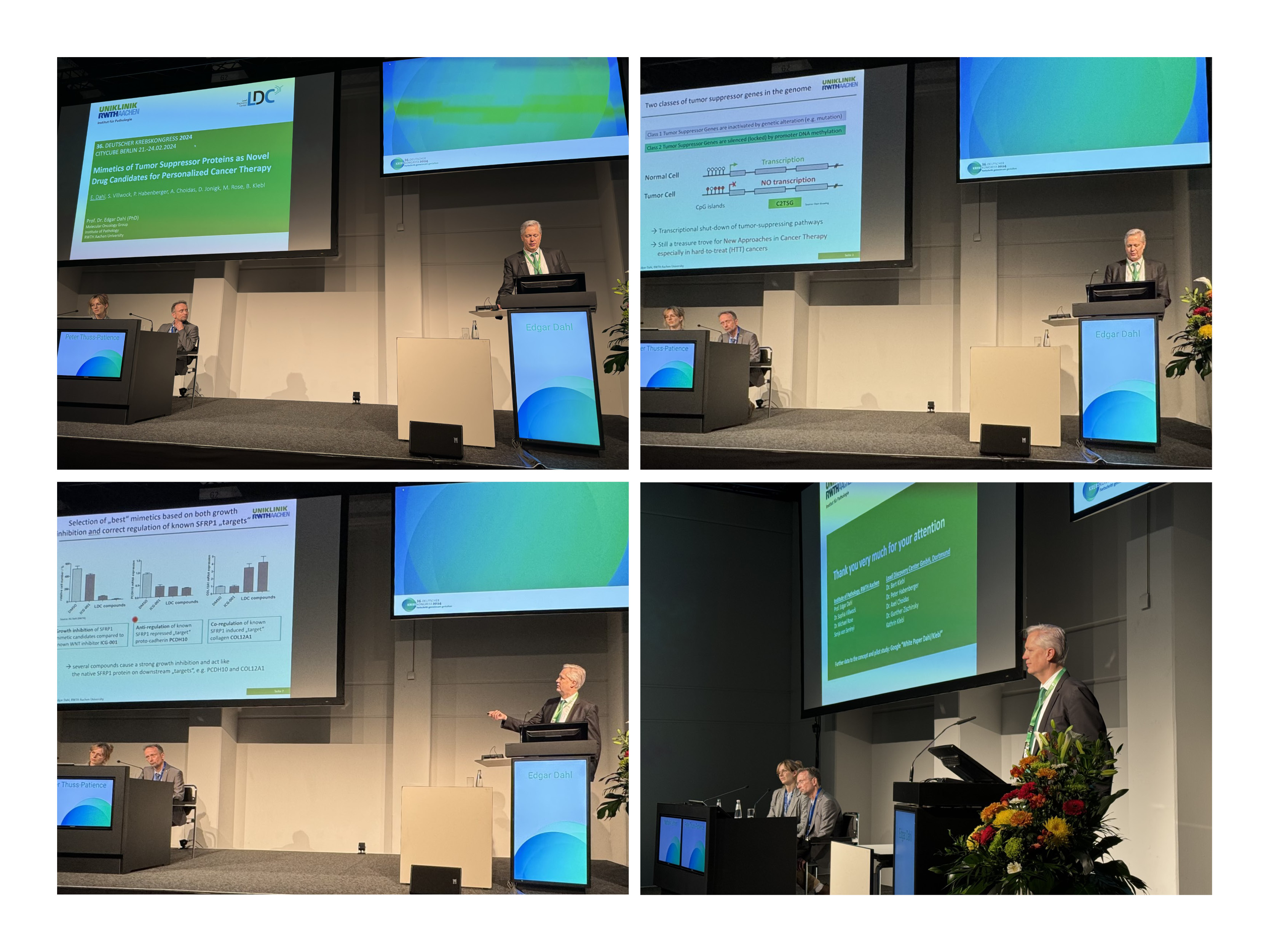
However, nowadays it is possible to search for biological agents or small molecules that can functionally replace (or mimic) the lost tumor suppressor function. Our research group has identified several new C2TSGs in breast cancer, the loss of which is closely associated with a more aggressive tumor type and disease progression. We hypothesize that the functional restoration of these C2TSGs by mimetic drugs represents a new innovative way to treat cancer, a concept that we recently published as a white paper. In addition, this concept was recently presented at the 36. Deutscher Krebskongress 2024 (DKK2024) in Berlin within the Session "Best of Abstracts" by Prof. Edgar Dahl (photos).
An example of a very strong C2TSG in breast (and bladder) cancer is the ITIH5 gene (see Rose et al. 2017 and Rose et al. 2021).
With initial support from the RWTH Aachen Innovation Fund and the recent project acquisition by the RWTH spin-out project Qithera, we are characterizing ITIH5 polypeptides that can mimic the tumor suppressive function of ITIH5.