

Methods
In our research, we use a combination of different methods. These include eye tracking, computer-based tasks, and both functional and structural magnetic resonance imaging (MRI). Below, we briefly introduce these methods.
Magnetic Resonance Imaging (MRI)
Magnetic resonance imaging (MRI) is a technique that allows us to visualize the structure of the brain in detailed images. Functional MRI (fMRI) additionally provides information about the activity of different brain areas. This makes the method particularly useful for gaining insights into the brain, how it works, and how it develops.
In our study, we use magnetic resonance imaging. Most of the time, we call it MRI or brain camera.
What exactly is an MRI?
Basically, the MRI is a very big camera. With this camera, we can take fascinating pictures of the brain. The brain camera looks a bit like a spaceship or a big tunnel that you can crawl through.
How does the MRI or brain camera work?
Our brain camera looks a bit like a spaceship. You can lie down inside and do different things, like play games or solve tasks. While you do that, the brain camera takes pictures of your brain.
Just like in a real spaceship, the brain camera makes loud noises! To protect your ears, you’ll wear headphones. It’s also very important to lie as still as possible — otherwise, the pictures get blurry, just like when you move while someone takes a photo.
What happens on the day of the scan?
Before you see the real brain camera, we’ll first show you our practice camera. It also looks like a big spaceship! You’ll have plenty of time to explore it and learn how everything works.
For example, we’ll show you all the different parts of the brain camera. Then you’ll get to hear the kinds of sounds it makes.
When you look at this picture, you’ll already know what the brain camera looks like before you come to visit us:

Once we’ve answered all your questions, you’ll get to do an MRI scan with your stuffed animal first! After that, you can try it yourself — lying still inside the brain camera with headphones on.
When you feel comfortable and ready, we’ll move on to the real brain camera. That’s when we’ll take amazing pictures of your brain while you look at different pictures or videos.
Eye Tracking – Measuring Eye Movements
During eye tracking experiments, the eyes are recorded with a camera. This method allows us to determine, for example, which letters a person looks at while reading, or which part of a face they focus on.
Our eye tracking system uses an infrared camera. The participant’s face is illuminated with a faint infrared light, which is completely harmless and not noticeable to the participant. Eye tracking is very well suited for young children, too. Typically, our participants sit at a table and look at pictures on a computer screen or complete short tasks.
Computer or Tablet Tasks
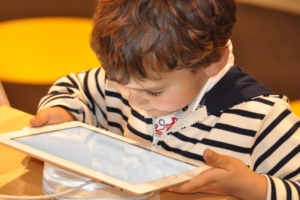
To learn more about how important processes—such as recognizing faces, letters, and words—develop throughout childhood, we also use tasks on a computer or tablet. In these tasks, for example, children might first memorize a face and then try to recognize it among a group of other faces.

