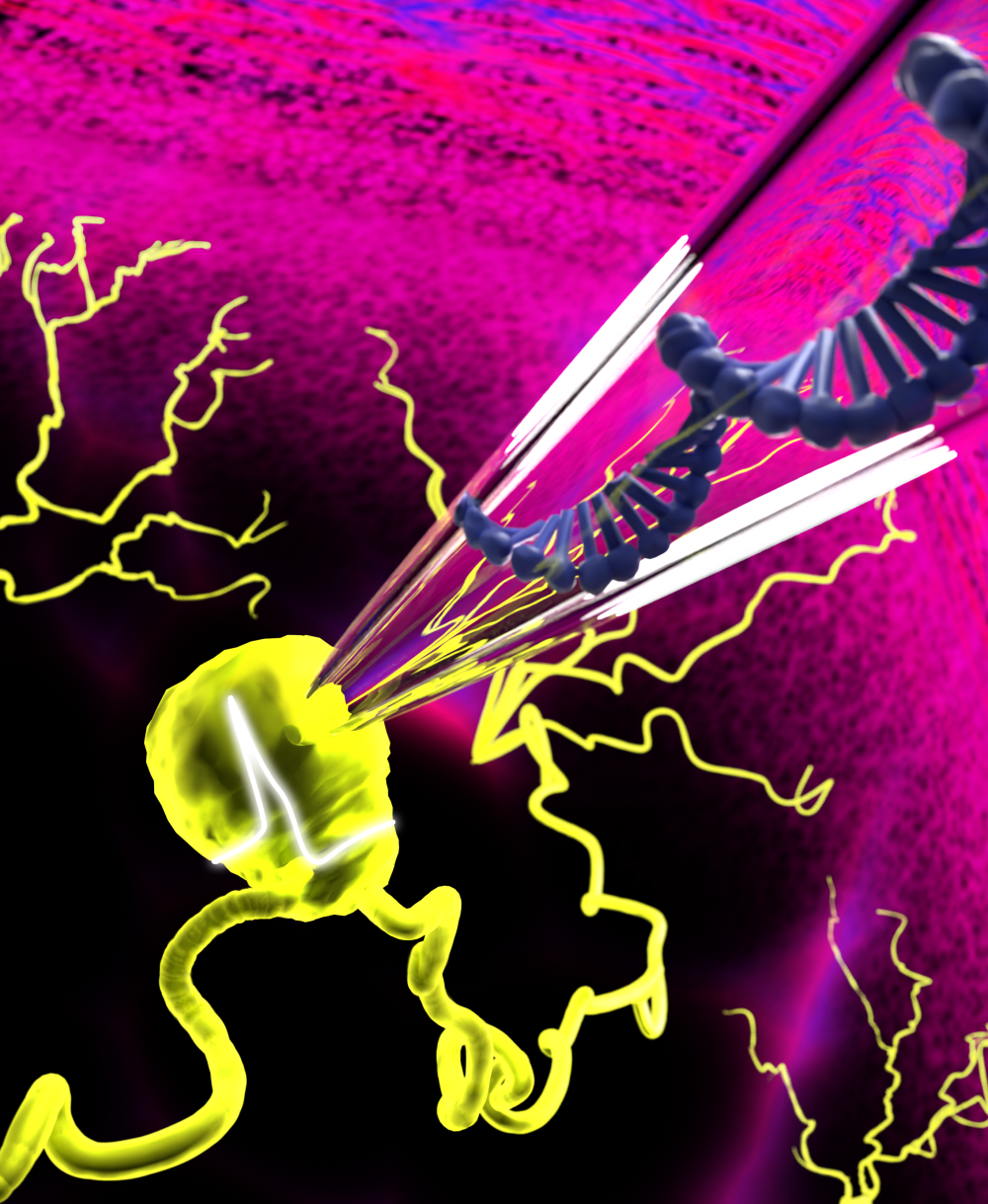





Researchers from the Institute of Neurophysiology at Uniklinik RWTH Aachen and the Krembil Centre for Neuroinformatics at CAMH and University of Toronto, have deciphered the molecular signature of so-called human sleeping nociceptors. These fibers represent a distinct class of sensory neurons that are unresponsive to touch or pressure and play a central role in neuropathic pain. The findings have now been published in the renowned scientific journal Cell.
Approximately ten percent of the population suffer from neuropathic pain, which is frequently associated with spontaneous activity of sleeping nociceptors. These neurons become spontaneously active in chronic pain states, to cause persistent pain even without an external stimulus. Although the functional properties of these fibers have been known for many years, their molecular identity remained unclear, thereby lacking a critical prerequisite for the development of targeted therapeutic interventions.
An international research team led by Univ.-Prof. Dr. Angelika Lampert (Director of the Institute of Neurophysiology and Spokesperson of the Scientific Center for Neuropathic Pain SCNAACHEN at Uniklinik RWTH Aachen), in close cooperation with Dr. Shreejoy Tripathy (Senior Scientist, CAMH and University of Toronto), has now closed this key knowledge gap. By combining high-resolution electrophysiological recordings with techniques that read the genetic activity of individual neurons, the researchers identified a clearly defined neuronal population with sleeping nociceptor properties.
To succeed, the team had to translate between the distinct 'languages' of neuronal electricity and genetics. Co-first author Dr. Jannis Körner (Lampert Lab, Aachen) recorded the electrical activity of individual neurons using Patch-Seq, a cutting-edge method that combines electrophysiology with single cell genetic sequencing. These data were then integrated with comprehensive bioinformatics analyses led by co-first author Derek Howard (Tripathy Lab, Toronto). This collaboration produced a “Rosetta stone” for pain research, bridging the gap between animal models and human biology. Importantly, the team used pigs as a key translational model, as pigs (unlike mice) possess sleeping nociceptors in their skin that closely resemble those found in humans. This allowed the team to finally assign a molecular identity to these elusive neurons, uncovering specific targets for future pain therapies.
Molecular Hallmarks of Sleeping Nociceptors
The team’s analyses reveal that sleeping nociceptors are defined by a specific molecular signature, which includes, among other components, the oncostatin M receptor (OSMR) and the neuropeptide somatostatin (SST). Co-first author Dr. Körner explains: “The findings also point to additional drug targets, including the ion channel Nav1.9, which was highly expressed in sleeping nociceptors and contributes to their distinctive electrical properties.” Targeting Nav1.9 may enable the development of medications that selectively quiet these pain-causing neurons.
Co-first author Derek Howard adds: "Our bioinformatics analyses pointed to OSMR as a marker of sleeping nociceptors, but that's just a prediction until someone tests it. What made this collaboration special was our colleagues' willingness to take that prediction and validate it." Remarkably, the team's confidence in their findings extended to the final experiments and several senior study authors actively supported the human microneurography recordings performed in Aachen by Barbara Namer (Würzburg) and Jordi Serra (London, UK). “In these experiments, we showed that oncostatin M, which activates OSMR, specifically modulates sleeping nociceptors in the human skin. This confirmed our molecular predictions directly in humans,” explains co-first author Dr. Körner.
“Our work establishes a new conceptual framework for understanding the emergence of neuropathic pain at the molecular level, while at the same time opening concrete perspectives for the development of new, targeted therapies,” adds Prof. Lampert.
Multi-Disciplinary International Team
Prof. Lampert highlights the importance of the collaboration: “This work demonstrates the power of interdisciplinary and international cooperation. The success of the study relies on the close integration of specialized centers: while the key experiments were performed in Aachen, crucial single-cell and spatial transcriptomic efforts were undertaken in Mannheim and Dallas.” Dr. Tripathy adds: “It was a privilege to be part of such an 'all-star' team of experts. This project is a testament to what can be achieved when we combine diverse scientific perspectives to solve a common problem.”
For the molecular analyses, the team worked closely with Univ.-Prof. Dr. Ingo Kurth and Dr. Natja Haag from the Center for Human Genetics and Genomic Medicine. In addition, parts of the results were integrated into a computational model of the sodium channels of a sleeping nociceptor by Prof. Dr. Thomas Stiehl (Joint Research Center, Institute for Mechanistic Modelling in Computational Biomedicine). Junior Professor Dr. Jenny Tigerholm (also Joint Research Center) conducted parts of the psychophysical and microneurographic experiments in humans.
The research team was further strengthened by contributions from the groups led by the renowned pain researchers Barbara Namer (now University of Würzburg), Jordi Serra (King’s College London, UK), Martin Schmelz and Hans-Jürgen Solinski (Heidelberg University, Mannheim), Ted Price (University of Texas, Dallas, USA), and William Renthal (Harvard University, USA).
The publication is available at the following link.
A summary and explanation of the research findings by Prof. Dr. Angelika Lampert and Shreejoy Tripathy can be found in this video.
Molecular Architecture of Human Dermal Sleeping Nociceptors
Jannis Körner, Derek Howard, Hans Jürgen Solinski, Marisol Mancilla Moreno, Natja Haag, Andrea Fiebig, Anna Maxion, Shamsuddin A. Bhuiyan, Idil Toklucu, Raya A. Bott, Ishwarya Sankaranarayanan, Diana Tavares-Ferreira, Stephanie Shiers, Nikhil N. Inturi, Esther Eberhardt, Lisa Ernst, Lorenzo Bonaguro, Jonas Schulte-Schrepping, Marc D. Beyer, Thomas Stiehl, William Renthal, Ingo Kurth, Jenny Tigerholm, Jordi Serra, Theodore Price, Martin Schmelz, Barbara Namer, Shreejoy Tripathy, and Angelika Lampert
Körner et al., 2026, Cell 189, 1–16
March 19, 2026 © 2025 The Authors. Published by Elsevier Inc.
https://doi.org/10.1016/j.cell.2025.12.048